
概要
刃物の「切れ味(Sharpness)」は、単なる官能的な指標ではなく、刃先先端半径(Apex Radius: Rapex)と、被切断物の微細構造との相互作用によって定まる物理現象です。 本稿では切れ味を、マクロな破壊から原子レベルの分断に至るまでの物理的背景をもとに、11のクラスに分類し、それぞれのレベルに対応する代表的なベンチマークを提示します。
本分類は、刃先形状および切断挙動の観察に基づき整理したものであり、分子レベルでの切断機構については既知の物理モデルに基づく解釈を含みます。
特に、Rapex 50 nm付近には、切断メカニズムが「組織の粘弾性的な逃げ」から「分子結合の直接的な断裁」へと移行する臨界的な領域が存在します。 この境界を越える「Matrix Edge」の領域では、鋼材中の巨大な炭化物は研磨の障害となり、マトリクス(母材)そのものの平滑性と界面の安定性が支配的な因子となります。
本分類の目的は、エンジニアリングの視点から刃先の幾何学的精度を再定義し、材料工学および光学的な検証に基づくシャープニングの到達領域を、観察的な事象と関連付けて示すことです。
刃先先端半径と切断の挙動に基づく刃物の切れ味の分類
| Class | Classification | Description | Apex Radius (Rapex) [nm] | Benchmark / Visual Reference |
|---|---|---|---|---|
| 10 | Damaged | Severe edge degradation | > 1000 | Visible nicks or chips |
| 9 | Dull | Utility/Axe grade | 500 - 1000 | Apex reflects light |
| 8 | Working Edge | General-purpose stationery tools | 300 - 500 | Slices newsprint or copy paper |
| 7 | Sharp | High-quality kitchen knives (well maintained) | 200 - 300 | Cuts tissue paper without snagging No light reflection from apex |
| 6 | Very Sharp | Professional chef's knives | 120 - 200 | Cuts tissue paper with reduced lint Minor fiber disturbance |
| 5 | Ultra Sharp | Fine woodworking plane | 80 - 120 | Clean cut, minimal lint Continuous fiber severing Translucent softwood shavings |
| 4 | Extremely Sharp | High-grade blade steel Matrix-dominated edge with minimal carbide interference Upper bound often limited by micro-carbide discontinuities |
50 - 80 | Cuts hair by catching cuticle (hair whittling) |
| 3 | Matrix Edge (I) | Ultra-fine Razor Primary matrix planarization Requires near-continuous matrix with negligible carbide effects |
30 - 50 | True Floating Cut: Transverse severing (ignore cuticle) |
| 2 | Matrix Edge (II) | Microsurgery Scalpels Interfacial boundary stabilization |
20 - 30 | Cut nerves and vessels precisely |
| 1 | Molecular Edge | Glass microtome Precise to handle cells |
5 - 20 | Cuts sections as thin down to ~200 nm |
| 0 | Atomic Edge | Diamond microtome ~12-atom edge thickness |
< 3 | Cuts sections as thin as 50 nm |
Definitions
- Matrix Edge: An edge whose sharpness is governed primarily by the continuous matrix rather than discrete carbide features.
Notes
- Edge radius values represent effective radius under practical use conditions, including wear and surface state.
- "Atomic-scale" specifications are often expressed in atom counts; these correspond to a few-nanometer effective edge radius rather than a strictly defined geometric curvature.
Class 4+ Example (End-Grain Cutting)
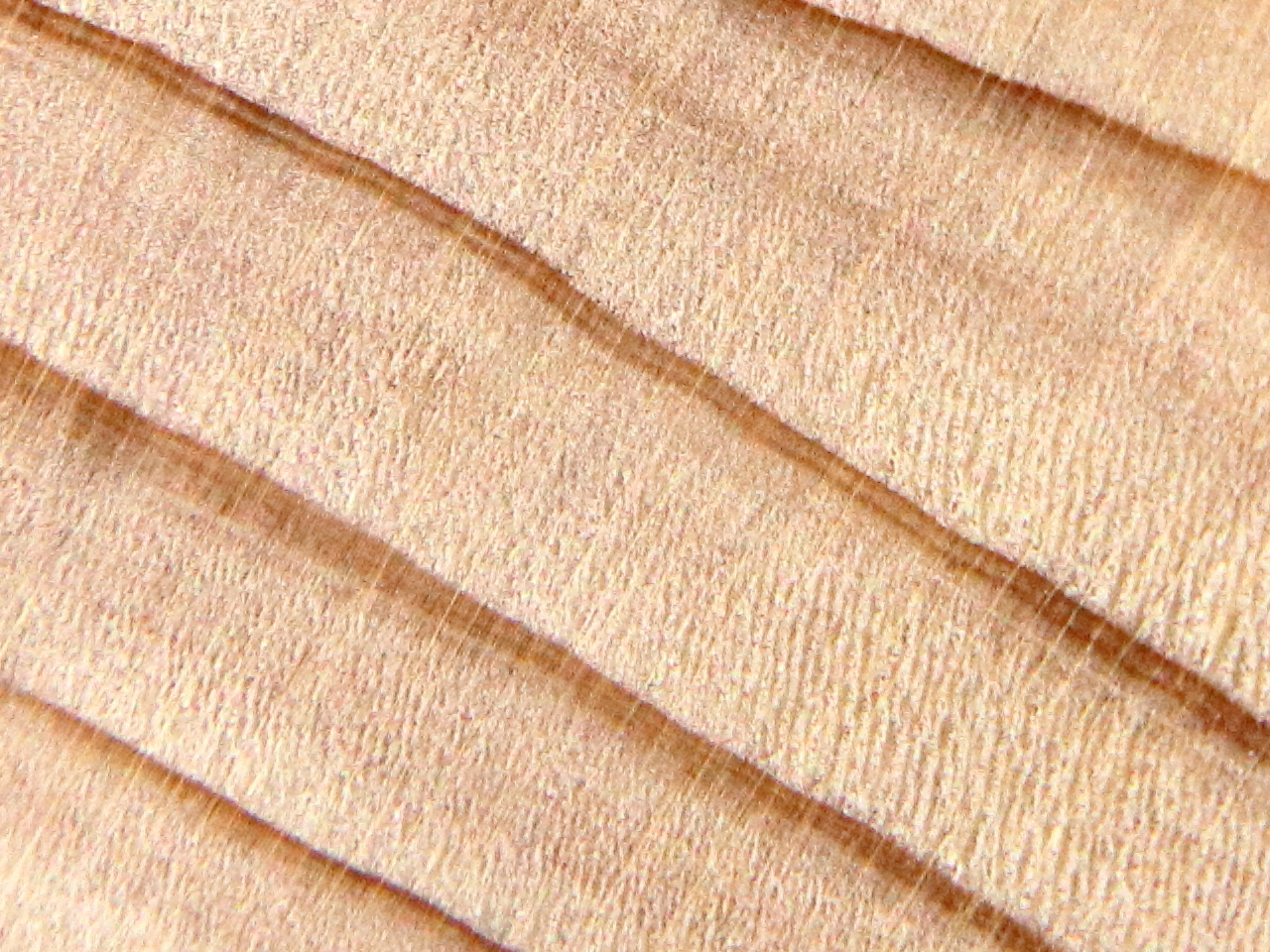
Hinoki (cypress) end-grain cross-section:
Cellular structure remains largely intact, including dense latewood regions,
indicating a shear-dominated, matrix-controlled cut with minimal crushing.
(Class 4+, approaching Class 3)
Cutting direction is set at approximately 45° to the growth rings to distinguish material structure from potential tool marks.
The fine linear textures are intrinsic to the wood microstructure and not machining artifacts.
Finished using a Blue Paper Steel #2 blade; minor surface scattering may reflect fine carbide effects.
The fine linear textures are intrinsic to the wood microstructure and not machining artifacts.
Finished using a Blue Paper Steel #2 blade; minor surface scattering may reflect fine carbide effects.
Class 3 Demonstration (True Matrix Edge)
True Floating Cut: transverse severing without cuticle anchoring
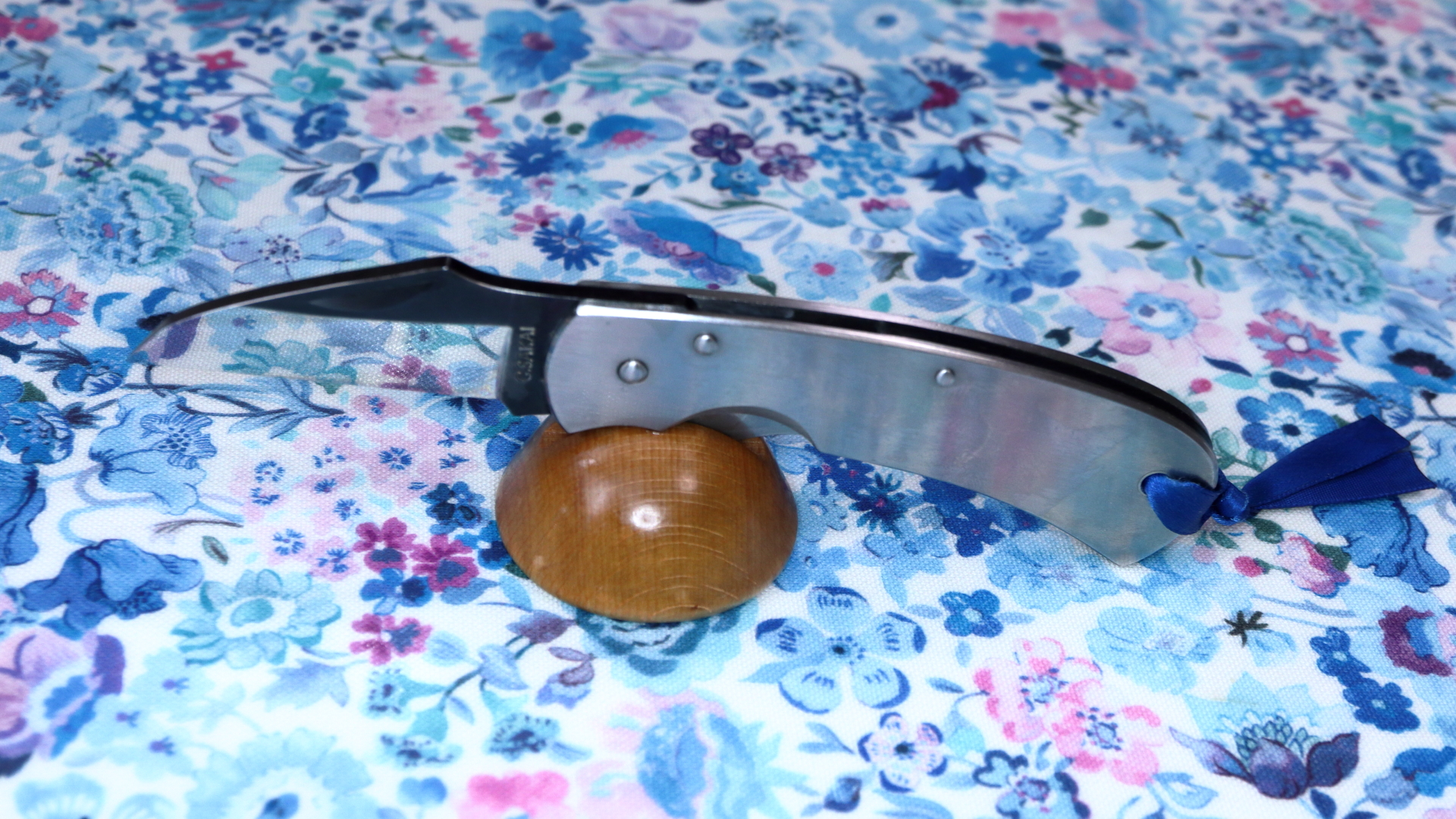
Demonstrated on coarse, straight human hair using a carbon steel blade (G. Sakai AR301SS).
The cut is achieved without relying on cuticle engagement, indicating a matrix-dominated edge beyond carbide-limited behavior.
Reference Examples
- Obsidian scalpel: molecular edge (< 5 nm)
- Glass ultramicrotome: ~3?4 nm local apex, ~100 nm sectioning capability
関連サイト
- Science of Sharp — SEM-based analysis of cutting edges and sharpening mechanisms.
- Matzelle TR, Kruse N, Reichelt R. Characterization of the cutting edge of glass knives for ultramicrotomy by scanning force microscopy using cantilevers with a defined tip geometry. J Microsc. 2000 Sep;199 (Pt 3):239-43. doi: 10.1046/j.1365-2818.2000.00733.x. PMID: 10971804. — Direct measurement of glass knife apex geometry at nanometer scale.