

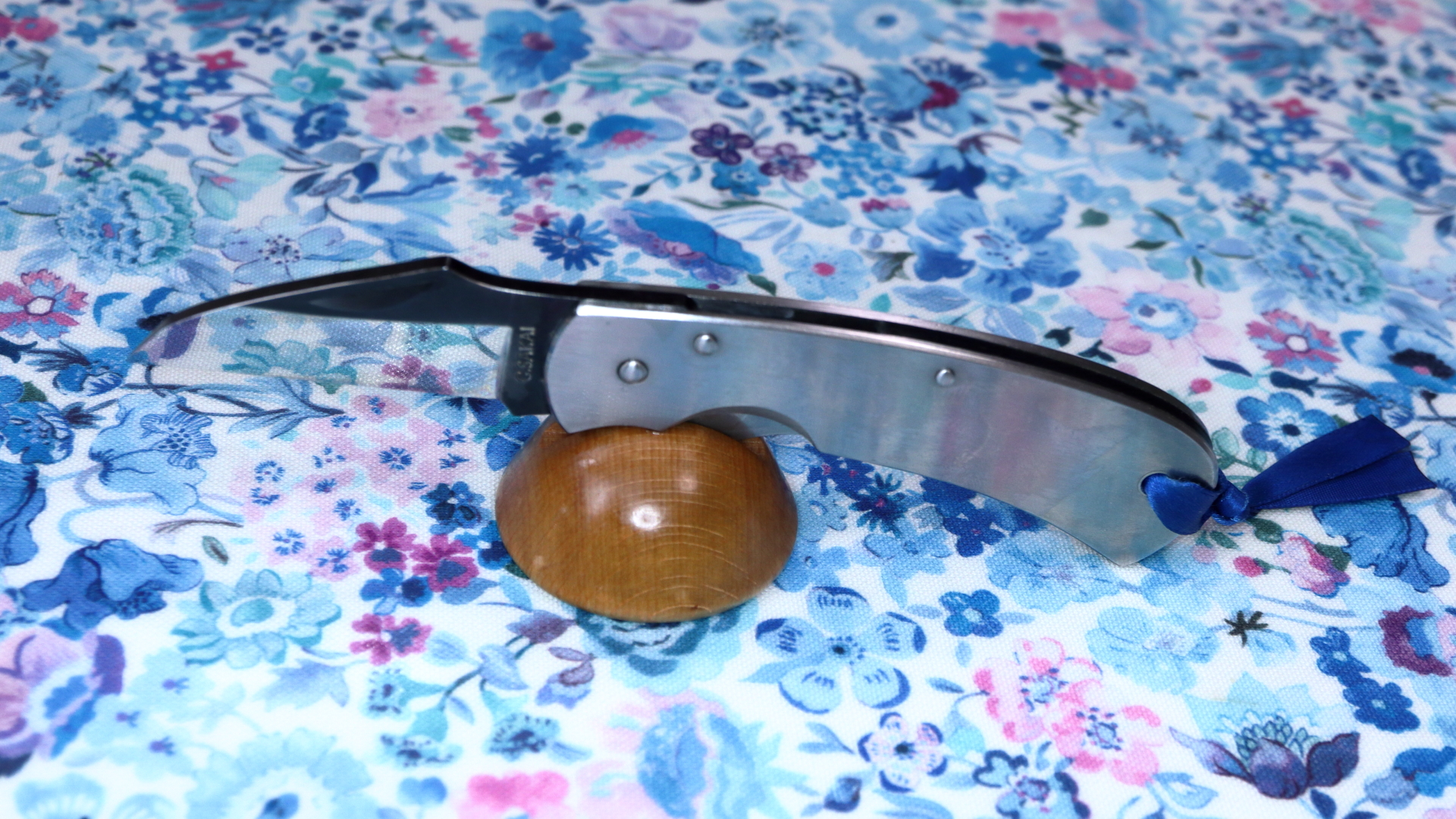
Overview
Sharpness of a cutting edge is not merely a subjective or sensory attribute, but a physical phenomenon governed by the interaction between the apex radius (Apex Radius: Rapex) and the microstructure of the material being cut. In this article, sharpness is classified into 11 distinct classes, ranging from macroscopic fracture to atomic-scale separation, based on the underlying physical mechanisms. Representative benchmarks corresponding to each level are presented.
This classification is organized based on observations of edge geometry and cutting behavior. Interpretations of cutting mechanisms at the molecular scale are included based on established physical models.
In particular, around Rapex ≈ 50 nm, there exists a transitional regime in which the cutting mechanism shifts from viscoelastic deformation of the material to direct severance of molecular bonds. Beyond this boundary, in the regime referred to as the "Matrix Edge," large carbides within the steel act as obstacles to sharpening, and the smoothness of the continuous matrix and the stability of interfacial boundaries become dominant factors.
The purpose of this classification is to reinterpret the geometric precision of cutting edges from an engineering perspective, and to relate the attainable sharpening regimes to observable phenomena.
Sharpness Classification of Cutting Edges Based on Apex Radius and Cutting Behavior
| Class | Classification | Description | Apex Radius (Rapex) [nm] | Benchmark / Visual Reference |
|---|---|---|---|---|
| 10 | Damaged | Severe edge degradation | > 1000 | Visible nicks or chips |
| 9 | Dull | Utility/Axe grade | 500 - 1000 | Apex reflects light |
| 8 | Working Edge | General-purpose stationery tools | 300 - 500 | Slices newsprint or copy paper |
| 7 | Sharp | High-quality kitchen knives (well maintained) | 200 - 300 | Cuts tissue paper without snagging No light reflection from apex |
| 6 | Very Sharp | Professional chef's knives | 120 - 200 | Cuts tissue paper with reduced lint Minor fiber disturbance |
| 5 | Ultra Sharp | Fine woodworking plane | 80 - 120 | Clean cut, minimal lint Continuous fiber severing Translucent softwood shavings |
| 4 | Extremely Sharp | High-grade blade steel Matrix-dominated edge with minimal carbide interference Upper bound often limited by micro-carbide discontinuities |
50 - 80 | Cuts hair by catching cuticle (hair whittling) |
| 3 | Matrix Edge (I) | Ultra-fine Razor Primary matrix planarization Requires near-continuous matrix with negligible carbide effects |
30 - 50 | True Floating Cut: Transverse severing (ignore cuticle) |
| 2 | Matrix Edge (II) | Microsurgery Scalpels Interfacial boundary stabilization |
20 - 30 | Cut nerves and vessels precisely |
| 1 | Molecular Edge | Glass microtome Precise to handle cells |
5 - 20 | Cuts sections as thin down to ~200 nm |
| 0 | Atomic Edge | Diamond microtome ~12-atom edge thickness |
< 3 | Cuts sections as thin as 50 nm |
- Matrix Edge: An edge whose sharpness is governed primarily by the continuous matrix rather than discrete carbide features.
- Edge radius values represent effective radius under practical use conditions, including wear and surface state.
- "Atomic-scale" specifications are often expressed in atom counts; these correspond to a few-nanometer effective edge radius rather than a strictly defined geometric curvature.
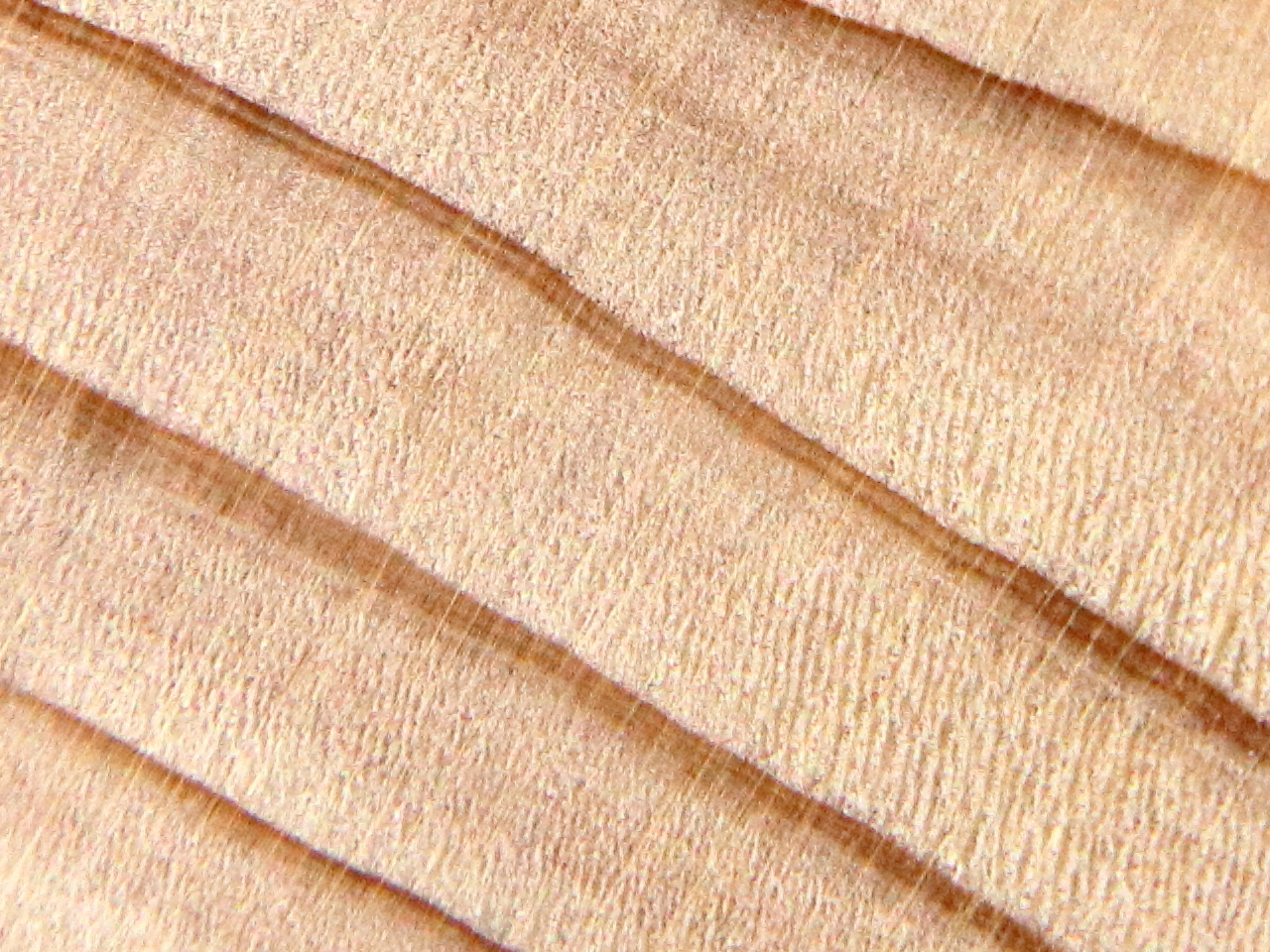
The fine linear textures are intrinsic to the wood microstructure and not machining artifacts.
Finished using a Blue Paper Steel #2 blade; minor surface scattering may reflect fine carbide effects.
- Obsidian scalpel: molecular edge (< 5 nm)
- Glass ultramicrotome: ~3?4 nm local apex, ~100 nm sectioning capability
Related Resources
- Science of Sharp — SEM-based analysis of cutting edges and sharpening mechanisms.
- Matzelle TR, Kruse N, Reichelt R. Characterization of the cutting edge of glass knives for ultramicrotomy by scanning force microscopy using cantilevers with a defined tip geometry. J Microsc. 2000 Sep;199 (Pt 3):239-43. doi: 10.1046/j.1365-2818.2000.00733.x. PMID: 10971804. — Direct measurement of glass knife apex geometry at nanometer scale.